
- News
- City News
- mumbai News
- Activists still debating Mumbai Metro 3 carbon footprint, green impact
Trending
This story is from May 9, 2023
Activists still debating Mumbai Metro 3 carbon footprint, green impact
Contractors L&T for MMRC are planning to get the Metro 3 car shed ready in time for the commissioning of the project's Phase I by the year-end.
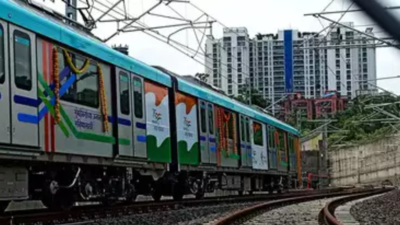
Image used for representational purpose only
Even as the work nears completion, relocation of the car shed to Aarey and the cutting of trees at night in 2019 at the site is an issue that continues to rankle, say activists.
Despite the Metro team highlighting the benefits to the city, a section of activists and researchers are convinced the line could have been commissioned without damage to green cover.

Hussain Indorewala, urban researcher, said the detailed project report for Metro 3 had listed alternative sites. "The most suitable was BKC. But it was rejected as it has high commercial value. So they moved to another to exploit its potential for commercial development."
Envrionmentalist Amrita Bhattacharjee said Aarey should have been avoided at all costs because it is the catchment of Mithi river. In a city seen as increasingly vulnerable to flash floods, she represents the view that the car shed will alter the course of run-offs from the river.
But MMRC MD Ashwini Bhide says potential gains from the line far outweigh any negative implications. She said once the line is up, the carbon footprint of the project will be offset within 80 days. "This project is beneficial as it will have a daily ridership of 17 lakh which will help decongest the city and take away 6.5 lakh vehicles off the roads, which in turn will save around 4.5 lakh litres of fuel every day."
She said the environmental impact of construction at Aarey was assessed by auditors of the UN Framework Convention on Climate Change, who said 2.6 lakh tons of CO2 emissions will be reduced every year. "This is far more ecologically beneficial to us and will compensate immensely for lost carbon sequestration due to the cutting of trees."
However, some activists question MMRC's claims of reduction in carbon emissions. One of them, Zoru Bhathena, says the existing metro lines have barely made a dent in traffic congestion on Western Express Highway. Others like Indorewalla say the value attached to trees that had to make way for the Metro 3 depot cannot be measured in terms of the monetary cost of timber. Bhattacharjee said data from the 2021 Metro Lines 3 and 6 integration report reveals that of the 1,582 trees transplanted only 572, or 36%, survived. As for the project's carbon footprint, she said the underground line cannot depend on natural light or ventilation. "Not only the trains, but stations need to be air-conditioned and hence Metro 3 will result in a larger carbon footprint," she said.
Amid protests, the Supreme Court had ordered MMRC to replant all the trees that were cut for the car shed as well as at the station sites at the locations from where they were cut. "All along the corridor 10-15 trees have been replanted," said an activist. But Bhide said, "We have planted six to seven times the trees that were cut. They are all grown and surviving. The court asked us to replant the grown trees at the stations. We have with us around 4,000 trees that are ready to be replanted. However, the same locals who went and took part in the protest are not giving us the place required to replant the trees."
End of Article
FOLLOW US ON SOCIAL MEDIA









Photostories

Hot Picks
TOP TRENDING
Popular Categories
Hot on the Web
Top Trends
Israel Hezbollah WarMost Runs in International CricketVirat KohliIND vs BAN Live ScoreRohit SharmaIndian Team Fastest Test FiftyMohammed SirajUGC NET Result 2024TS DSC Results 2024Women T20 World Cup Points TableWomen T20 World Cup ScheduleShane McMahon Net WorthHezbollah ChiefTourists Not AllowedDiddyTop Management Colleges of IndiaLive Cricket Score
Trending Topics
Devara CollectionMithun ChakrabortyKangana RanautNavratri WishesGandhi Jayanti WishesAnant AmbaniDevara CollectionGandhi Jayanti 2024Masala OmeletteEmergencyDevaraTaaza Khabar 2 Twitter ReviewDevara Movie ReviewHealthy RaitasSwatantrya Veer SavarkarColdplay India tour 2025Smartphone DealsApple Macbook Air M1Amazon SaleWordle Answer
Living and entertainment
Latest News
iVoomi S1 Lite e-scooter launched at Rs 84,999: 180 km range, three-year warranty!Tata Nexon turbo CNG: Variant-wise features with price explainedThe Power of Color: Zodiac Signs and Their Energetic HuesPMI in India intensifies efforts against Illicit Tobacco Trade to Safeguard Economic Interests and Consumer Protection'For the next 10 years, we've got players who will make our country proud' says VVS Laxman on bench strengthBarbra Streisand pays tribute to late 'A Star Is Born' co-star Kris Kristofferson: 'He was something special'Sasikumar and Simran join hands for a feel-good, city-based entertainerQueen Camilla does not want King Charles to meet Prince Harry because...Watch: Jasprit Bumrah’s lethal inswinger shatters Mushfiqur Rahim’s off stumpOlivia Culpo and Christian McCaffrey buy George Clooney's mansion for $14.5 millionPaul Heyman opens up on declining TNA offer after leaving WWEHow can Ben Stokes and other overseas players avoid a two-year IPL ban?Colleagues remember braveheart Delhi Police constable Sandeep: 'Would rush to crime scene alone'Header: Kolkata metro conducts public awareness campaign at Dum Dum metro station"Tyler Huntley’s 'Snoop' Nickname: The Rapper Connection Explained”Bigg Boss 18 Promo: Salman Khan reveals the theme of the season by predicting the contestants' future in the houseBTS star V crowned 'Most Handsome Man in the World 2024'Decoding a bowl of Idli Sambhar: From calories to nutrients
Copyright © 2024 Bennett, Coleman & Co. Ltd. All rights reserved. For reprint rights: Times Syndication Service